
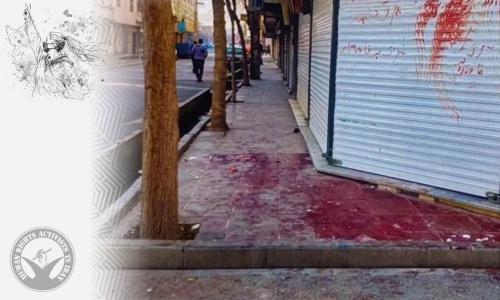
24 January 2026 :
January 23, 2026 - IRAN. Hrana Report on 27th day of protests: 5,137 confirmed deaths, 12,904 still under investigation.
Strong Condemnation of Iran’s Regime at the UN Human Rights Council
On the 27th day of nationwide protests, according to HRANA’s aggregated data, the number of confirmed deaths has reached 5,137, while cases still under review stand at 12,904. In addition, at least 7,402 people have suffered serious injuries during the protests, and the total number of arrests has risen to 27,797. These figures have been recorded as nationwide internet shutdowns and disruptions have entered their third consecutive week. The release of new reports on targeted arrests, the broadcast of forced confessions, and the extension of United Nations human rights mandates were among today’s other major developments, reflecting the government’s efforts to control the narrative and continue its crackdown on protesters.
On the twenty-seventh day of nationwide protests, developments continued along three main axes rather than showing any de-escalation:
- the continuation of communication restrictions, with NetBlocks reporting the entry into a third week of internet shutdowns (348 hours);
- the expansion of arrests and summonses, alongside the growing prominence of security-related cases and “forced confessions”; and
- the intensification of international reactions, centered on a special session of the UN Human Rights Council and the adoption of a resolution extending the mandates of the Special Rapporteur and the fact-finding mission.
NetBlocks Reports 348 Hours of Internet Shutdown and “False Traffic”
One of the main focal points of today’s developments was the continued internet shutdown and the management of communications. According to NetBlocks, Iran’s nationwide internet blackout has entered its third week, reaching 348 hours. While noting a “slight increase in connectivity,” NetBlocks also reported signs of efforts to generate false traffic and to create the impression of a widespread restoration of internet access.
At the same time, media reports present a similar picture: on the one hand, some users have experienced limited connectivity for short periods; on the other hand, monitoring organizations say this access is neither stable nor widespread, and that indicators of a “staged return of the internet” are visible in the data.
The continuation of the internet shutdown has two direct effects on the protest movement:
- A reduction in the speed and accuracy of documenting human rights violations (including identifying victims, recording the time and location of incidents, and enabling communication between families and media outlets or civil society organizations).
- A shift in the form of protests and activism; as internet-based coordination tools are restricted, some actions move toward more fragmented, localized, and lower-cost forms, while at the same time citizens face greater difficulty in warning one another about the risks of arrest and other forms of government repression.
Additionally, in today’s international meetings, “internet shutdowns” were highlighted as one of the key examples of human rights violations, and the UN Human Rights Council emphasized, within its demands and expectations, the necessity of restoring citizens’ access to the internet.
Arrests, Summonses, Forced Confessions, and Fabricated Charges
On the 27th day, information on arrests and summonses emerged across several layers: HRANA’s field and news reports on scattered arrests in various cities; coverage of specific individual cases; and statistics and claims issued by security institutions regarding the scope of arrests and intelligence operations.
According to the published report, at least 22 citizens were arrested in the cities of Kerman, Tehran, Semnan, and Lumar in Ilam Province. At the same time, a video containing “forced confessions” from five citizens was released, with the circumstances of its recording reported as unclear. Additionally, news emerged of the recent arrests of Abdolreza Ghandehari (a teacher) and Mohsen Baver in Neyshapur and Abdanan.
In addition to the statistics and scattered arrests, there were reports of individual cases of arrest by security forces: HRANA reported that Artin Ghazanfari, a Baha’i citizen and photojournalist, was arrested at his private residence in Tehran on January 19 and transferred to an undisclosed location.
Another report also referred to individual arrests: Saeed Dorudi (a student) in Tehran, Danial Bahrami in Javanrud, and Vahid Latifnejad and Yazdan Azizi in Ilam were arrested. In addition, the commander of the Abdolazim Corps in Rey County announced the arrest of five individuals in the county, labeling them as “leaders of the protests.”
At another level, state-affiliated media also reported mass arrests, including reports of the detention of 148 people in Hamedan on charges such as “manufacturing and distributing hand grenades,” and allegations of links to “Israel and the Iran International network,” as well as news of the arrest of “three four-member teams involved in damaging public property” and two foreign nationals.
Meanwhile, the IRGC Intelligence, in its official narrative, spoke of the arrest and summoning of 735 individuals and the “guidance and admonition of 11,000 people,” while simultaneously making claims about the discovery of weapons and the identification of networks allegedly linked to foreign intelligence services.
In this context, forced confessions continue to be one of the government’s key tools in its “narrative-building project.” The release of confession videos usually serves two functions simultaneously: first, creating a climate of deterrence and social fear; and second, producing media material to attribute the protests to “external/organized agents” and to legitimize repression. Today’s reports indicate that this mechanism, alongside “quiet but large-scale arrests,” is becoming increasingly entrenched.
Special Session of the Human Rights Council
Adoption of a Resolution and Extension of the Mandates of the Special Rapporteur and the Fact-Finding Mission
The most significant international development related to the protests on the twenty-seventh day was the UN Human Rights Council’s special session on Iran, held in Geneva. The session took place on Friday, January 23, 2026, and was specifically dedicated to examining the human rights situation and the suppression of the January protests. During the session, the proposed resolution was adopted with 25 votes in favor. Under the resolution, the mandate of the Special Rapporteur on the situation of human rights in Iran was extended for one year, and the mandate of the UN fact-finding mission was extended for two years. This session was described as the third special session of the Human Rights Council on Iran over the past three years and was convened at the request of civil society organizations, with the support of 23 Council member states.
According to supplementary accounts, Cuba, Pakistan, Egypt, and China opposed the proposal and called for a vote. Ultimately, the resolution was adopted with 25 votes in favor, 7 votes against, and 14 abstentions.
In terms of substance, at the opening of the session, senior UN human rights officials expressed concern over the “unprecedented scale of violent repression” in reference to the scope of the protests and the government’s response. They highlighted reports of extrajudicial killings, the lethal and disproportionate use of force, mass arrests, and internet shutdowns as serious examples of human rights violations.
Mai Sato, the Special Rapporteur on the situation of human rights in Iran, also warned in her remarks that the use of terms such as “terrorist,” “rioter,” and “mercenary” by officials of the Islamic Republic to describe peaceful protesters serves to justify violence and obscure the popular nature of the protests. She emphasized that the use of lethal force must be a “last resort” and carried out in accordance with the principles of necessity, proportionality, and legality, principles which, she said, were widely violated during the January crackdown.
Statistics
- Number of recorded gatherings/protests: 640
- Number of cities involved (no duplicates): 194 cities
- Number of provinces involved (no duplicates): 31 provinces
- Confirmed deaths: 5,137
- Protesters: 4,834
- Minors (under 18): 54
- Government/affiliated forces (military and non-military): 208
- Non-protesters/civilians: 41
- Deaths under investigation: 12,904
- Severely injured: 7,402
- Total arrests: 27,797
- Arrests of individuals under 18: 175
- Arrested students: 54
- Broadcasts of forced confessions: 200 cases
Summary
The twenty-seventh day of protests was marked by the continuation of internet shutdowns into a third week, an increase in arrests, and the growing use of forced confessions. At the same time, the UN Human Rights Council adopted a resolution extending the mandates of the Special Rapporteur and the fact-finding mission.
Alongside these developments, the geopolitics of the region and new sanctions have become increasingly intertwined with Iran’s internal crisis, further heightening the diplomatic sensitivity of Iran’s case.