
01 February 2026 :
January 31, 2026 - IRAN. Hrana Report on 35th day of protests (b): 6,713 confirmed deaths, 17,091 under review.
Pressure on Medical Staff and Lawyers, Continued Arrests
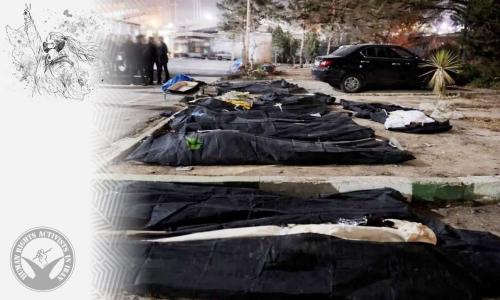
According to HRANA’s latest aggregated data on the 35th day since the start of the protests, the total number of confirmed deaths has reached 6,713. Based on these figures, 6,305 of those killed have been reported as “protesters,” while 137 are under 18. Additionally, 214 members of government-affiliated forces and 57 “civilian, non-protesters” have been reported killed. 17,091 cases remain under investigation. The number of injured civilians stands at 11,021, with 84 student arrests, 295 cases of forced confessions, and 11,028 summonses reported. A total of 662 protest-related incidents have been recorded across 205 cities in 31 provinces.
On the 35th day, the government’s repression continued on two parallel tracks: intensified pressure on lawyers and medical staff amid a wave of arrests and legal harassment, and the persistence of sporadic, targeted arrests across various cities, alongside the continued use of repressive tactics such as broadcasting “forced confessions” and issuing security summonses.
Crackdown on Lawyers and Doctors
Recent reports indicate that security pressure has not been limited to the streets, but has increasingly targeted individuals who, by virtue of their professions, are responsible for assisting protesters, namely lawyers providing legal representation and defense for detained protesters, and doctors and medical staff treating those injured during the protests.
Arrests of Lawyers and Uncertainty Over Numbers and Charges
Saeed Bagheri, vice president of the Central Bar Association, has said that there is no precise information on the number of lawyers arrested during the recent protests, noting only that it has been “heard that a number of colleagues” have been detained. He also stressed that the exact reasons for the arrests and the nature of the charges have not been clarified to the Bar Association, adding that the case of Shima Ghoosheh is set to be reviewed by a working group.
In this context, Shargh newspaper reported that nine lawyers have been arrested since the start of the protests, writing that two lawyers were detained in Tehran, six in Shiraz, and one in Mashhad. The report also noted that a number of other lawyers have been summoned, without providing full details.
According to the published list, the seven detained lawyers are: Mehdi Ansari, Ja’far Zarei, Mehran Ansari, Ja’far Kashavarz, Nazanin Baradaran, Enayatollah Karamati, and Omid Darabi. HRANA had previously reported the arrest of two other lawyers, Shima Ghoosheh and Mohammad Hadi Jafarpoor.
Regarding Shima Ghoosheh’s case, it has been reported that she was arrested by security forces at her home in Tehran on January 16, and that her family remains in “complete lack of information” about her condition. These reports, together with repeated references to detainees being held in “undisclosed locations,” have intensified concerns over access to legal counsel and the transparency of judicial proceedings.
Heavy Bail, Restrictions on Legal Representation, and Prison Sentences
At the same time, three lawyers spoke to Etemad newspaper, providing details from detainees’ case files that offer a more concrete picture of judicial proceedings:
Zahra Minouei said she is currently handling around 17 cases related to recently detained individuals, most of whom were born in the 2000s. According to her, the charges in these cases are mainly “disrupting public order and tranquility” and “assembly and collusion against the country’s internal and external security.” She also reported the imposition of heavy bail and the continuation of detention even after bail has been granted, noting that in many cases the bail order is not lifted in practice. Minouei added that the sentences issued so far have largely been prison terms, with the shortest sentence reported at seven months and the longest at five years.
Maryam Kian-Arthi said that in many cases, interrogating judges have refused to accept privately chosen defense lawyers. Referring to Article 48 of the Criminal Procedure Code, she explained that during the preliminary investigation stage, only lawyers approved by the head of the judiciary are permitted to represent defendants. She also noted that the legal fees charged by some of these approved lawyers are extremely high and beyond the financial means of families, who in many cases are also unable to provide the required bail.
Hassan Aghakhani said he has so far taken on three cases, all involving the charge of “assembly and collusion against national security.” He stated that the detainees are from Eslamshahr, central Tehran, and Pardis, and that lawyer-client meetings have not yet been allowed. He also cited overcrowded prisons, the lack of transparent information, and difficulties in arranging powers of attorney as ongoing challenges.
Doctors and Medical Staff: Official Narratives Versus Field Reports
Regarding pressure on healthcare personnel, the gap between official narratives and published field reports remains significant. Following reports of doctors and medical staff being arrested after treating those injured during the Dey protests, Mohammad Raiszadeh, head of the Iranian Medical Council Organization, said that 17 doctors with judicial and security cases had “not been arrested due to medical treatment” and that no “final verdicts” have so far been issued against them. While confirming the existence of cases against these individuals, he stressed that no doctor has been detained solely for performing medical duties, adding that the Medical Council has followed up on the matter through security and judicial authorities.
At the same time, Mohammadreza Zafarghandi, Iran’s Minister of Health and Medical Education, said in a message that providing the best possible medical services to every patient in a “safe and hygienic environment” is the priority of the healthcare system, and that this principle underpins the professional conduct of medical staff and forms part of their oath. Similarly, Homayoun Sameh-Yah Najafabadi, a member of Parliament’s Health and Treatment Commission, said he had reviewed a list of detained doctors and found the number of names to be “not small.” However, when asked about the reasons for the arrests, he said he was unaware and claimed he doubted the detentions were related to treating the injured. He also sought to describe medical facilities as “safe,” despite field reports indicating that injured protesters fear going to hospitals.
In contrast to the official narrative, numerous reports have emerged of doctors being arrested after treating injured protesters. Among the names cited are Ameneh Soleimani (a physician and director of a dermatology and hair clinic in Ardabil), Babak Pouramin (an emergency medicine specialist in Neyshabur), and Alireza Golchini (a surgeon from Qazvin). According to accounts from relatives and colleagues, these individuals faced security forces after providing medical care.
In response to the arrests of medical staff, Ahmad Nejatian, head of the Iranian Nursing Organization, said the organization would issue a statement and clarify its position. Additionally, the group “Physicians and the Law” warned in a statement that the “criminalization of medical treatment” contradicts fundamental principles of criminal law, and that issuing heavy sentences against doctors who have merely carried out their professional duties could lead to “judicial intimidation” among medical staff, an outcome that, in times of crisis, both reduces the quality of emergency care and jeopardizes citizens’ right to access medical services.
Arrests and Other Repressive Measures
Alongside pressure on lawyers and healthcare personnel, reports indicate the continued use of street-level and security arrests in various cities, detentions that in some cases have involved transfers to undisclosed locations and, in others, the release of videos of “forced confessions.”
In Iranshahr, it has been reported that three citizens were arrested, including a 17-year-old teenager named Mohammad Ahourani and Amirhossein Kadkhodaei. The same report also mentions the arrest of a woman identified as Fasih Borhanzahi.
Regarding arrests related to teachers, reports state that Behzad Ghavami, a teachers’ union activist based in Sanandaj, has been detained for 21 days, with no information available about his place of detention. Additionally, Mohsen Khodaei, a teacher from Javersian, a village in Khondab County in Markazi Province, was arrested 24 days ago, and no precise information has been released about where he is being held.
In Rasht, the city’s police commander announced the arrest of a “blogger” in connection with the protests. In Lahijan, two protesting citizens were reportedly arrested, and a video of their “forced confessions” was released simultaneously—a video whose recording conditions remain unclear. In addition, the arrest of another citizen in Lahijan has also been reported.
On a broader scale, reports indicate that 430 citizens have been arrested in various cities during the protests. Within this context, the arrests of Amirhossein Heydari (a student at Gorgan University) and Nima Raziani (a resident of Kermanshah) have also been reported. Furthermore, the prosecutor of Eslamshahr announced the arrest of at least 300 citizens in the city, while the Intelligence Department of South Khorasan Province stated that it had detained 128 individuals described as “key elements affiliated with monarchist groups and the Baha’i faith.”
In another development, it has been reported that Mehdi Mahmoodian, Abdollah Momeni, and Vida Rabbani were arrested and transferred to an undisclosed location. According to reports, the arresting authority has not been officially identified, and the three have been described as signatories of the “Statement of 17.”
Statement by the Teachers’ Trade Association
On the 35th day, the Iranian Teachers’ Trade Association (Tehran) issued a statement condemning the “killing and bloody suppression of protesters,” declaring in unequivocal language: “We stand, with full commitment, alongside the people’s justice-seeking and freedom-demanding aspirations,” and emphasizing teachers’ social responsibility in the face of the current situation.
The statement was released amid simultaneous reports of the arrest of teachers’ union activists and a lack of information about the whereabouts of some detainees, including reports of the arrest of Behzad Ghavami in Sanandaj and the detention of Mohsen Khodaei in Javersian, Markazi province. Taken together, these developments suggest that the professional sphere of education, like other areas of civil society, has come under increasing security pressure.
Beyond condemning the crackdown, the Teachers’ Trade Association’s statement also conveys a practical warning: the continuation of judicial and security measures against professional and civil activists could lead to public distrust and deepen social divides. The association’s emphasis on standing with “justice-seeking and freedom-demanding” demands, set against reports of arrests and case-building, indicates that segments of the professional community are seeking to preserve their own narrative and to warn of the consequences of ongoing repression.
Statistics
- Fatalities
- Protesters: 6,305
- Including minors: 137
- Military/government forces: 214
- Non-civilian, non-protesters: 57
- Total deaths: 6,713
- Cases under review: 17,091
- Student arrests: 84
- Forced confessions: 295
- Summonses: 11,028
- Injured civilians: 11,021
- Total protest-related locations/incidents in cities: 662
- Provinces affected: 31
- Cities affected: 205
Conclusion
The events of the 35th day since the start of the protests indicate that pressure from security and repressive institutions has spread to broad segments of society: from the arrest and restriction of lawyers involved in legal defense, to the opening of security cases against doctors and conflicting accounts regarding the reasons for their detention. At the same time, sporadic arrests, summonses, and reports related to forced confessions continued. Professional bodies, including the Teachers’ Trade Association, issued statements warning of the consequences of sustained repression.