
25 January 2026 :
January 25, 2026 - IRAN. IHR Report: Hundreds killed during protests in Rasht
Witness Accounts: “They Set Rasht Market on Fire and Opened Fire on People Fleeing the Deadly Flames”
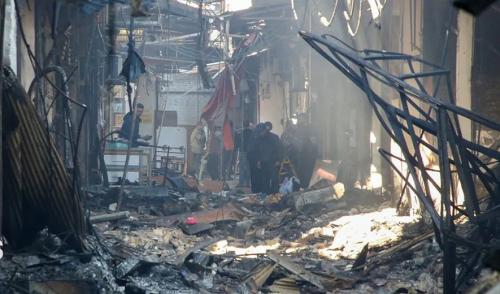
The protest in the city of Rasht resulted in one of the bloodiest crackdowns on the nationwide protests. According to eyewitnesses, hundreds of people were killed during these protests. More than 300 shops were burned after being set on fire by government forces, and citizens who had sought refuge in the market to escape the continuous gunfire from heavy military weapons were directly targeted.
Images of the burned shops in the deserted streets were among the first visuals broadcast by state television, at the same time as the internet blackout. State media described the events as a “terrorist incident” and blamed the protesters.
Despite the continued internet blackout and severe restrictions on access to information, parts of what witnesses describe as the “massacre of the people of Rasht” have gradually come to light. Four eyewitnesses to the bloody crackdowns in Rasht on 8 and 9 January have shared their accounts in separate interviews with IHR.
Start of Protests and Brutal Killings
The first witness, who left Iran after these events, told IHR: “What happened to us in Rasht is indescribable. What is being said on social media today is not even one hundredth of what we witnessed.” According to this witness, the Rasht market had been the scene of strikes and protests since 7 January, but the following day, on 8 January, large numbers of people took to the streets.
He said: “In the early hours, the crowd was huge and almost all the streets were full of people. At first, security forces were few in number and did not confront the crowd. Every moment, more people joined, and people were celebrating with the feeling that the city was in their hands. But after a few hours, as the numbers grew dramatically and the internet was cut, the military and security forces launched their attack and the repression and killing began. They used tear gas, pellet guns and live ammunition. People resisted, gunfire could be heard across the city until three or four in the morning.
A second witness described the beginning of the protests: “I was with some friends near the market. On 8 and 9 January, everyone gathered around Rasht’s Municipality Square. Gradually, thousands came. The streets were full of people, women, men, children and the elderly. We were chanting. We believed this time it was over for them. We had reached our limit. From Friday, they were firing live rounds without mercy. They tried to stop people from reaching the main streets, but most neighbourhoods resisted heavily. Despite the repression, even with direct gunfire, people took shelter behind alley walls and held their ground.”
The first witness said that part of the forces involved in the repression were linked to the Quds Force (special branch of the Islamic Revolutionary Guard Corps (IRGC)) and included both Iranian personnel and proxy forces. He added: “Some of them were speaking Arabic. Among them were very young people, Basij members aged 14 or 15, who had been given weapons.”
A fourth witness said: “I witnessed unbelievable scenes, as if a foreign army had entered the country and was massacring the people.” He added: “They beat the bodies of the dead with batons. They tried to forcibly take away the small child of one of the victims, but stopped after the mother screamed and cried. Anyone who fled into quiet alleys was chased and killed with live ammunition. One of my relatives was hit with around 60 pellet shots and dragged himself to a friend’s shop before being taken to hospital.”
Arson of Market
According to the witnesses, a group of protesters sought refuge in Rasht’s market on 8 January 8 January. The first witness said: “The agents set the shops and the market on fire. They shot at people who were fleeing the flames or arrested them. There were elderly people, young people and even children amongst the protesters. They spared no one. They finished off (coup de grâce) the wounded. That night, amid bullets, fire and blood, we saw hell with our own eyes.”
He added: “People in Rasht believe the government did this both to take revenge on striking shopkeepers and to create a narrative blaming protesters for the fire, in order to make the detainees’ cases heavier.”
The second witness said: “On Thursday, Rasht was out of control. No one could believe half the market had burned down. More than 300 shops were set on fire. Many say the agents themselves burned the market. Several Basij bases and other buildings were also burned. I have photos, but I’m afraid to send them. Rasht’s municipality looked like Gaza. What happened in Rasht is far worse than what has been reported.”
A third witness said: “On the evening of 8 January, there were huge crowds in Golsar and Moallem streets. The forces attacked and pushed people towards the city centre. In the market, many people were killed with gunfire. People hid in shops, but they set them on fire and shot those who ran out.”
A fourth witness said: “Near the market, they sprayed everyone with bullets. At first, we thought it was just to scare people, but it was live ammunition meant to kill. In Talesh, nearly 700 were killed. In Lahijan, people were killed. In Siahkal, at least eight were killed.”
Use of Live Ammunition and Abduction of Injured
The second witness described the high death toll during the protests in Rasht on 8 and 9 January: “On Friday, 9 January, there were four continuous hours of gunfire. They would not let people come out from the neighbourhoods onto the streets. They were lying in wait at the ends of alleys and shot anyone they saw. For example, they blocked Chahar Baradaran so people could not reach Motahhari Street. But people were so brave that the agents lost control and fired live ammunition. Under our building it was a battlefield. Two were killed and many were wounded. Every neighbourhood was like that. The casualties on Friday were huge. They did not kill a few. I don’t know, maybe it reached a thousand.”
According to the first witness, the security forces did not spare even the wounded who still had a chance of surviving. Many families, on the advice of hospital staff, took their wounded home out of fear that they would be arrested or killed by government forces: “Government agents abducted the wounded from hospitals and shot them at close range to finish them off. They piled unconscious or wounded protesters together with the dead in portable cabins. If someone was wounded or unconscious, they would shoot them at close range in front of other protesters.
“Bullet money”
One aspect of the crackdown in Rasht has been the authorities’ treatment of the families of those killed. According to the witnesses, families were contacted to collect the bodies and were informed of their loved one’s death in the most abusive and humiliating manner. One father was told: “Come and take your terrorist parasite and get out.”
Verified reports received by IHR indicate that the authorities demand money from families in exchange for handing over the bodies. If families cannot pay, they are given a sheet containing the names of detained protesters and are asked to state in writing that their son was a Basij member, that these detainees were the killers, and that the family demands their punishment.
According to this source, burial times are also determined by the security agencies, and are generally carried out at night. In some cases, families who cannot afford to pay are given a “discount”, but are told to come with a box of sweets in order to receive the body. Some families, because of the pressure and humiliation, have refused to go to collect their loved one’s body.
The third witness said: “I heard some families buried their children in their own yards, and others buried the bodies in the nearby mountains. It was said that money had been demanded from some of them and they did not have it. Others were buried secretly at night in a cemetery, but when the agents realised, they dug the bodies up and took them away.”
Rasht under heavy security after the crackdown
After the bloody crackdown, Rasht fell under a fully securitised and militarised atmosphere. Eyewitnesses said that agents raided homes in search of Starlink devices and satellite dishes. These raids were especially intense in areas such as Dehkadeh Saheli in Rasht.
According to eyewitnesses, many wounded people are still being cared for at home and, out of fear of arrest or being killed, are unable to seek treatment at medical centres.
The fourth witness described the city from 10 January onwards as resembling “areas of Europe occupied by Nazi German forces during the Second World War”. He said: “It is hard to imagine. Martial law was in place. The city became like a graveyard. Agents stood at the ends of alleys. The city fell silent.”
The exact number of those killed in Rasht is not known. However, the first witness said it is difficult to find a family that has not lost someone, or that does not have a relative who was injured. He added: “Many of those killed were young people who were their family’s only child. Now families have been left behind with nothing left to lose.” Even so, he stressed that the people of Rasht remain standing, sustained by the hope of “a free Iran.”
https://iranhr.net/en/articles/8552/