01 January 2026 :
December 31, 2025 - IRAN. IHR report on widespread and systematic drug executions in Iran
The international community, and in particular the UN Office on Drugs and Crime (UNODC), has a duty to act and ensure that cooperation with Iran does not enable or legitimise these killings carried out under the pretext of drug control.
As 2025 draws to a close, Iran is ending the year with more reported executions than in any other year since the late 1980s. While the final execution numbers for 2025 are still being verified, a process made arduous by Iran’s lack of judicial transparency, the available evidence already shows that more than 700 of the at least 1,500 people executed, were for drug-related offences. Those executed are overwhelmingly from the most marginalised sectors of Iranian society, including people living in poverty, ethnic minorities, foreign nationals and individuals with little or no access to effective legal defence.
Commenting on the report, Mahmood Amiry-Moghaddam, Director of IHR, stated “People sentenced to death for drug offences are the most voiceless and weakest victims of the Islamic Republic’s killing machine. These executions are not part of a ‘war on drugs’; they are a central part of the Islamic Republic’s war on its own people. By executing people on such a scale, the authorities seek to instil fear and prolong the life of a system that lacks legitimacy. The international community, and in particular the UN Office on Drugs and Crime (UNODC), has a duty to act and ensure that cooperation with Iran does not enable or legitimise these killings carried out under the pretext of drug control.” He added: “The large-scale and systematic executions of people for drug offences, carried out without due process and with the aim of instilling societal fear, must be investigated by the United Nations as crimes against humanity.”
According to data collected by IHR, Islamic Republic authorities have executed at least 5,356 people for drug-related charges between January 2010 and 30 November 2025. Amongst those executed were 121 women and at least seven individuals who were under 18 years old at the time of their alleged offences.
Despite the 2017 amendment to Iran’s Anti-Narcotics Law, introduced under international pressure and presented as a reform to reduce executions, the practice has continued at scale. Since January 2018, at least 2,132 people have been executed for drug-related offences, demonstrating that the amendment has failed to bring about a lasting reduction in the use of the death penalty for drug offences.
The report also documents the extraordinary lack of transparency surrounding executions in Iran. Over the past 15 years, Iranian authorities have officially announced only 10–30% of all executions. The situation is even more opaque for drug-related cases: since 2018, authorities have acknowledged just 2.4% of drug executions recorded by IHR, compared to 23.44% of executions for other charges. The vast majority of cases documented in this report are therefore based on executions independently verified by IHR through two separate sources.
Executions for drug-related offences have taken place in all 31 provinces of Iran. Notably, fewer than half of all recorded drug-related executions have occurred in border provinces, challenging official narratives that frame executions primarily as a response to cross-border trafficking.
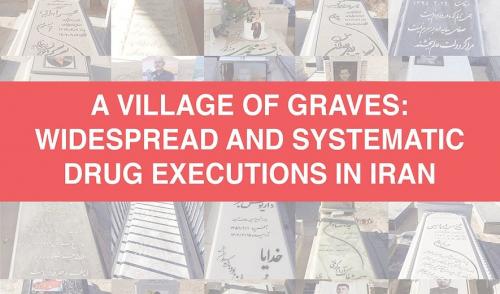
One of the most striking findings of the report concerns the village of Sartarhan Chah Kheyr in Lorestan province. With a population of fewer than 400 inhabitants, the village has seen around 70 people executed for drug-related offences between 2010 and 2025, while around 100 others, including three women, are currently on death row. Through geolocation and independent verification, IHR confirmed that dozens of those buried in a local cemetery were executed on drug charges. Several gravestones bear the same family names, illustrating a pattern in which multiple members of the same family or community are sentenced to death and executed over time.
Beyond the numbers, the report documents systematic violations of due process in drug cases, including torture-tainted confessions, denial of access to lawyers, trials lasting only minutes in Revolutionary Courts, and executions carried out despite unresolved legal challenges. It also highlights the disproportionate impact on ethnic minorities, particularly Baluch people, who account for 26% of all recorded drug executions since 2021 while representing only 2–5% of Iran’s population, as well as the execution of at least 111 Afghan nationals during the same period.
Published at the close of a year marked by rising repression, this report underscores how executions for drug offences have become a central feature of Iran’s use of the death penalty — carried out largely in silence, and borne disproportionately by those with the least power to defend themselves.
Scale and Patterns of Drug Executions (2010-30 November 2025)
According to IHR data, Iranian authorities have executed at least 5,356 people for drug-related charges between January 2010 and 30 November 2025. These include 121 women and seven child offenders. Drug-related executions account for more than 52% of all executions carried out in this period.
At least 2,132 people were executed after January 2018, following the 2017 amendment to the Anti-Narcotics Law, which was intended to reduce the use of the death penalty for drug-related offences.
Due to the lack of transparency in Iran’s judicial system, the majority of executions are not officially announced by the authorities. Over the past 15 years, the authorities have, on average, announced only 10–30% of all executions. As a result, the majority of executions included in this report are based on cases verified by IHR through two independent sources. The level of transparency is even lower for drug-related executions. Since 2018, the authorities have officially announced only 2.4% of all recorded drug-related executions.
Executions for drug-related offences have been carried out in all 31 provinces of Iran. The highest numbers have been recorded in Tehran/Alborz, particularly in Ghezel Hesar Prison, as well as in prisons located in Khorasan Razavi, Isfahan, Fars, Sistan and Baluchistan, South Khorasan, West Azerbaijan and Kerman provinces. Fewer than half of all recorded drug-related executions have taken place in border provinces.
At least 5,356 people were executed for drug-related charges between 2010-30 November 2025
At least 2,132 people have been executed for drug-related charges since the 2017 Amendment to the Anti-Narcotics Laws
Only 2.4% of drug executions recorded by IHR since the 2017 Amendment were announced by official sources compared to 23.44% for all executions.
At least seven7 child offenders have been executed for drug-related charges since 2010. Of those, three were Afghan nationals, one was a Pakistani national and three were Baluch minorities
At least 121 women have been executed for drug-related charges since 2010
https://iranhr.net/en/articles/8499/
https://iranhr.net/media/files/A_Village_of_Graves.pdf