
24 March 2026 :
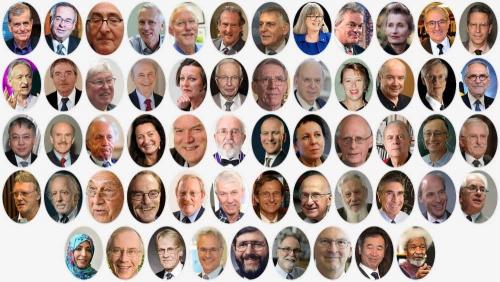
March 22, 2026 - IRAN. Joint Statement by 57 Nobel Laureates Endorses Democratic Roadmap for Iran
Fifty-seven Nobel laureates have issued a joint statement backing a democratic transition in Iran and endorsing a political roadmap advanced by the National Council of Resistance of Iran (NCRI).
In the March 2026 declaration, the laureates said Iranians have spent more than a century struggling for freedom, rule of law and human dignity, and argued that recent developments have created new hope for democracy following the death of the regime’s Supreme Leader Ali Khamenei. The statement recalled the January crackdown in which thousands of people protesting in more than 400 cities were reportedly killed, describing it as a massacre that shocked the world.
The signatories said Iranians have rejected both clerical rule and a return to monarchy, and instead are demanding a democratic republic. They stressed that Iran’s future should be decided by its own people through free elections, without war or foreign military intervention.
The laureates described the NCRI’s announcement of a provisional government, based on a Ten-Point Plan presented by Mrs. Maryam Rajavi, as an important step toward transferring sovereignty to the people. They said the plan supports free and fair elections, a market-based economy, separation of religion and state, gender and minority equality, a peaceful foreign policy, and a non-nuclear Iran.
Joint Statement by Nobel Laureates
In Support of Advancing Democracy and Sustainable Peace in Iran
March 2026
We, the Nobel laureates, with profound respect for the rich history and culture of the Iranian people, reemphasize that the people of this land have struggled for more than a century for freedom, the rule of law, and human dignity. Successive generations have paid a heavy price in their pursuit of a government that is accountable and grounded in the will of the people.
In January, we strongly condemned the heartbreaking massacre of thousands in Iran, individuals who had taken to the streets in more than 400 cities to demand freedom. This massacre, which shocked and horrified the world, was carried out on the orders of Ali Khamenei, the regime’s Supreme Leader. Now, in light of recent developments and Khamenei’s death, the people of Iran and the international community are more hopeful than ever for the realization of freedom and democracy in Iran.
The Iranian people have clearly rejected both monarchical dictatorship and clerical rule and instead are calling for a democratic republic. We believe that the path to democracy in Iran must avoid war and foreign military intervention and must rest on free elections and the protection of the rights of the people. Iran’s future should be determined by the Iranian people themselves, neither through coercion nor through the re‑creation of tyranny in any form. In this context, the announcement of a provisional government by the National Council of Resistance of Iran, an alliance comprising various political organizations and figures aimed at transferring sovereignty to the people and organizing free elections, and outlined in a 10‑point plan presented by Mrs. Maryam Rajavi, represents an important step and a significant development underscoring a commitment to a democratic transition.
Previously, 105 Nobel laureates and more than 4,000 parliamentarians, including majorities from numerous national legislatures such as those of the United Kingdom, France, Italy, Canada, Norway, as well as the U.S. Congress along with 130 former heads of state and government, endorsed this 10‑point plan. We stand in alignment with them.
This plan affirms free and fair elections, a market‑based economy, the separation of religion and state, gender, religious, and ethnic equality, a peaceful foreign policy, and a non‑nuclear Iran. It outlines a vision for a democratic Iran and lasting peace in the Middle East.
Signatories:
President Jose Ramos-Horta, Nobel Prize, Peace 1996, Timor-Leste. President of Timor-Leste Since 2022
Professor Pierre Agostini, Nobel Prize, Physics 2023, France
Professor Harvey J Alter, Nobel Prize, Medicine 2020, USA
Professor Victor Ambros, Nobel Prize, Medicine 2024, USA
Professor Robert Aumann, Nobel Prize, Economics 2005, USA-Israel
Professor Moungi Bawendi, Nobel prize, Chemistry 2023, USA-Tunisia-France
Professor Georg Bednorz, Noble prize, Physics 1987, Germany
Professor Mario Capecchi, Nobel Prize, Medicine 2007, Italy-USA
Professor Thomas Cech, Nobel prize, Chemistry 1989, USA
Professor Aaron Ciechanover, Nobel prize, Chemistry 2004, Israel
Professor Elias Corey, Nobel prize, Chemistry 1990, USA
Professor Johann Deisenhofer, Nobel prize, Chemistry 1988, USA
Professor Gerhard Ertl, Nobel prize, Chemistry 2007, Germany
Professor Jerome Friedman, Nobel prize, Physics 1990, USA
Professor Reinhard Genzel, Nobel prize, Physics 2020, Germany
Professor Sheldon Glashow, Nobel prize, Physics 1979, USA
Professor Oliver Hart, Nobel prize, Economics 2016, USA
Professor Geoffrey Hinton, Nobel prize, Physics 2024, Canada
Professor Roald Hoffmann, Nobel prize, Chemistry 1981, USA-Ukraine
Professor Robert Huber, Nobel Prize, Chemistry, 1988, Germany
Professor Michael Houghton, Nobel prize, Medicine 2020, UK,
Professor Louis Ignarro, Nobel prize, Medicine 1998, USA
Sir Kazuo Ishiguro, Nobel prize, Literature, 2017, UK
Elfriede Jelinek, Noble prize, Literature 2004, Austria
Professor Brian Josephson, Nobel prize, Physics 1973, UK
Professor Takaaki Kajita, Nobel Prize, Physics 2015, Japan
Tawakkol Karman, Nobel Prize, Peace 2011, Yemen
Professor Brian Kobilka, Nobel Prize, Chemistry 2012, USA
Professor Roger D. Kornberg, Nobel prize, Chemistry 2006, USA
Professor Robert Lefkowitz, Nobel prize, Chemistry 2012, USA
Professor Jean-Marie Lehn, Nobel prize, Chemistry 1987, France
Professor Eric Maskin, Nobel prize, Economics 2007, USA
Professor John Mather, Nobel Prize, Physics 2006, USA
Professor Michel Mayor, Nobel prize, Physics 2019, Switzerland
Professor Craig Mello, Nobel Prize, Medicine 2006, USA
Professor Paul Milgrom, Nobel prize, Economics 2020, USA
Professor Patrick Modiano, Nobel prize, Literature 2014, France
Professor Paul Modrich, Nobel prize, Chemistry 2015, USA
Professor Edvard Moser, Nobel Prize, Medicine 2014, Norway
Professor May-Britt Moser, Nobel Prize, Medicine 2014, Norway
Herta Muller, Nobel Prize, Literature 2009, Germany
Professor William Phillips, Nobel prize, Physics 1997, USA
Professor Sir Peter Ratcliffe, Nobel Prize, Medicine 2019, UK
Professor Charles M. Rice, Nobel prize, Medicine 2020, USA
Professor Sir Richard J. Roberts, Nobel prize, Medicine 1993, USA-UK
Professor Jean-Pierre Sauvage, Nobel prize, Chemistry, 2016, France
Professor Randy Schekman, Nobel prize, Medicine 2013, USA
Professor Richard Schrock, Nobel prize, Chemistry 2005, USA
Professor Gregg Semenza, Nobel prize, Medicine 2019, USA
Professor Danny Shechtman, Nobel prize, Chemistry 2011, Israel
Professor Vernon Smith, Nobel prize, Economics, 2002, USA
Professor Wole Soyinka, Nobel prize, Literature 1986, Nigeria
Professor Donna Strickland, Nobel Prize, Physics 2018, Canada
Professor Jack Szostak, Nobel prize, Medicine 2009, USA
Professor Olga Tokarczuk, Nobel Prize, Literature 2018, Poland
Professor Arieh Warshel, Nobel prize, Chemistry 2013, USA-Israel
Jody Williams, Nobel prize, Peace 1997, USA