
11 February 2026 :
February 10, 2026 - IRAN. Hrana Report on day 45 of the protests: 6,984 confirmed fatalities, 11,730 under review
Nighttime Chants and Intensified Police Presence
Based on the latest verified aggregated data from HRANA up to the end of the 45th day since the start of the protests, a total of 676 protest-related incidents has been recorded. These incidents were reported in 210 cities across 31 provinces nationwide. According to these figures, the total number of confirmed fatalities stands at 6,984, of whom 6,490 are categorized as protesters.
Additionally, 215 of those killed fall under the category of minors under 18. A further 214 fatalities were reported among government-affiliated forces, and 65 in the category of non-protester civilians. The number of cases under review has been reported as 11,730. During the same period, 18,022 civilian injuries, 52,623 arrests, 135 student arrests, 335 forced confessions, and 11,051 summonses were recorded.
On this day, the following key incidents are noteworthy: the continued chanting of anti-government slogans coinciding with state-organized events ahead of the anniversary of the victory of the 1979 Revolution on February 11; an intensified police atmosphere marked by the continued presence of checkpoints and armed local patrols; ongoing internet disruptions and restrictions and their economic impact; the publication of a statement by university professors protesting educational repression; and the continuation of both mass and individual arrests across multiple provinces.
Chanting of Anti-Government Slogans; Nighttime Protests Concurrent with State Ceremonies
On the 45th day, numerous reports were published of anti-government slogans being chanted at night, primarily from inside private homes. These chants were reported concurrently with the holding of state-organized programs and ceremonies ahead of February 11 (the anniversary of the victory of the 1979 Revolution) and were heard simultaneously in several cities.
According to field accounts, the slogans were explicit and direct in nature, demonstrating the continuation of the nationwide protests despite the prevailing security atmosphere and widespread control measures. The repetition of this pattern on consecutive nights, particularly during symbolically significant dates on the calendar, was highlighted in reports from this day as one of the enduring forms of civil disobedience.
Continued Checkpoints and Armed Local Patrols Ahead of February 11
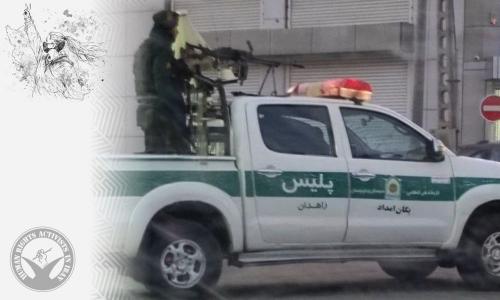
Reports from the 45th day point to the continued and intensified presence of security forces across urban areas. According to these accounts, checkpoints remained in place on both main thoroughfares and side streets, with vehicles stopped and, in some cases, citizens subjected to body searches.
Simultaneously, the deployment of armed local patrols and combined units of law enforcement and security forces in residential neighborhoods was reported. Local sources say these measures have contributed to an atmosphere of intimidation and constant surveillance ahead of February 11. As a result, opportunities for public gatherings, collective movement, and even routine daily activities have been significantly curtailed.
Continued Internet Disruptions and Restrictions; Communication and Economic Consequences
Today, reports indicated the continued disruption and restriction of internet access. Users reported severe slowdowns, intermittent outages, and unstable connections, conditions that have not only disrupted everyday communication and information-sharing but have also had tangible economic consequences.
Online business operators, internet-based sellers, and freelancers reported sharp declines in income, forced suspension of activities, or the accumulation of ongoing losses. Overall, internet restrictions, combined with other economic pressures, were assessed in reports from this day as a key factor contributing to heightened public dissatisfaction.
Statement by University Professors; Protest Against Educational Repression and the Securitization of Universities
Today, a group of university professors issued a statement protesting educational repression and the increasing securitization of university environments. The statement emphasizes students’ right to education, the preservation of academic independence, and opposition to suspensions, expulsions, and the denial of educational access.
The signatories warned that the closure or restriction of universities constitutes part of a broader effort to suppress protests and will carry long-term educational, social, and scientific consequences.
Mass Detentions and Judicial Case-Building Against Students and Minors
On the 45th day, HRANA reports indicated mass arrests and security measures in various cities. According to published information, official media reported the arrest of at least 103 citizens in connection with the protests. These arrests included 100 citizens in Ardabil, one individual in Bandar Anzali, and two citizens in Masjed Soleyman. In most of these cases, no details were provided regarding the identities of those detained, their place of detention, or the charges against them, and families were reported to be unaware of their relatives’ whereabouts.
At the same time, it was reported that at least 10 additional citizens, including a 15-year-old minor and several students, were arrested in different cities. Mohammad Hossein Khorshidvand, a 15-year-old, was arrested in Kahrizak, while Mohammad Javidan in Sirvan, Ebrahim Rostami in Kamyaran, Fardin Seyedeh in Piranshahr, and Anvar Chopani in Miandoab were detained by security forces. In Sanandaj, Akam Zandi was also arrested and transferred to an unknown location.
In the same context, Sajad Mohammadi and Mohammadreza Ghobadi, two students at Shahid Madani University of Tabriz; Sirus Satarnejad, a student at Shiraz University; and Ali Taheri-Kia, a student at the University of Tehran, were arrested.
In another series of arrests, HRANA reported the detention of five citizens in Tehran, Qazvin, Mashhad, and Isfahan. In this case, Zahra Irandoust was arrested in Tehran and later transferred to Chubindar Prison in Qazvin. Subsequently, her mother, Masoumeh Heydari, was arrested by IRGC Intelligence agents while attempting to follow up on her daughter’s case, and at the same time Mohammadreza Irandoust, another member of the family, was also arrested in Qazvin. Additionally, Reza Ghorbani Moghaddam was arrested in Mashhad, and Elaheh Shah Mirzaei was arrested in Isfahan and transferred to prison.
Further reports indicated that Afshin Hosseinpanahi and Khabat Dahdar, two residents of Sanandaj, were arrested by security forces and transferred to an unknown location. In another case, nine citizens were arrested on different dates in Tehran, Karaj, Kamyaran, and Rasht. Among them were Artin Parivash (Dolatabadi), Davoud Abbasi, a filmmaker based in Karaj, Milad Ebrahimi and Hamed Ebrahimi in Kamyaran, Yazdan Hashemi Khoshkbijari in Rasht, and Melika Kavandi and Mohammad Nosrati in Karaj. In addition, Fatemeh Golmohammadi in Karaj, Armin Sharifian, a 17-year-old minor, in Nishapur, Soroush Safari in Khoshkbijar, and Alireza Mirkhorsandi in Langarud were also arrested. In many of these cases, no clear information has been published regarding the charges, place of detention, or access to legal counsel.
Statistics
- Total recorded protest-related incidents: 676
- Number of cities: 210
- Number of provinces: 31
- Civilian injuries: 18,022
- Total arrests: 52,623
- Student arrests: 135
- Forced confessions: 335
- Summonses: 11,051
- Total protesters killed: 6,490
- Including minors: 215
- Military/government forces: 214
- Non-civilian / non-protester: 65
- Total fatalities: 6,984
- Cases under review: 11,730
Summary
The 45th day unfolded with the continued presence of nighttime protests, a further intensification of the police atmosphere ahead of February 11, and persistent restrictions on communication. At the same time, universities remained a central focus of security pressure and professional dissent, with the statement issued by university professors amplifying concerns over educational repression. On the ground, widespread arrests—ranging from mass detentions announced through official figures to targeted arrests of students, minors, and local citizens—underscored that a security-centered approach continues to be the authorities’ primary response to the protests. HRANA’s aggregated statistics through the end of the 45th day offer a stark illustration of the scale and severity of the crackdown, highlighting the ongoing need for systematic documentation, monitoring, and follow-up.
https://www.en-hrana.org/day-45-the-protests-nighttime-chants-and-intensified-police-presence/