
03 March 2026 :
March 2, 2026 - IRAN. Hrana Report on the 3rd Day of war
Rising Casualties and Intensified Strikes in Tehran and Western Provinces
In the last 24 hours, and as of March 2, 2026, at 17:00 ET, HRANA recorded at least 56 incidents across 13 provinces, resulting in 101 total casualties (killed and injured, civilian and military). All figures and classifications in this report are preliminary and may be updated as additional information becomes available and verification efforts continue.
Based on information verified today, HRANA has recorded 85 civilians killed and 5 total civilians injured, as well as 11 military personnel killed. During the last 24-hour period, 579 cases (deaths and injuries) remain under review for verification and classification, including assessment of whether individuals were civilians or military personnel.
In addition, in the last 24 hours, 28 objects were reported as hit. These include a range of locations and infrastructure, such as several military bases, two residential areas, and Shahid Bahonar Pier in Bandar Abbas. The nature of these objects, whether under special protected status, civilian, military, or dual use, remains under review, and classifications may be revised as further information becomes available. The list of 28 recorded targets are included in this report and reflect both objects reportedly directly targeted and those documented as damaged due to nearby strikes or collateral effects.
Aggregated data since the beginning of the conflict on 28 February 2026: The total number of reported civilian deaths stands at 742, including 176 children under 18, with 624 reported deaths currently and under review pending verification and classification. Reported civilian injuries since 28 February 2026 stand at 971, including 115 children.
This report provides a preliminary analysis of incidents documented within the last 24 hours. All figures and classifications contained herein are based on information available at the time of publication. As verification efforts continue and additional information becomes available, casualty figures, classifications of individuals as civilian or military, and the categorization of damaged objects may be updated.
HRANA applies a verification methodology that relies on cross-checking field reports, local sources, medical and emergency contacts, and available open source material. In cases where information cannot yet be conclusively verified, incidents or casualties are classified as undetermined and remain under active review. The dynamic nature of the situation, access constraints, and communication disruptions may affect the completeness of current data.
1- Overview of Incidents in the Last 24 Hours
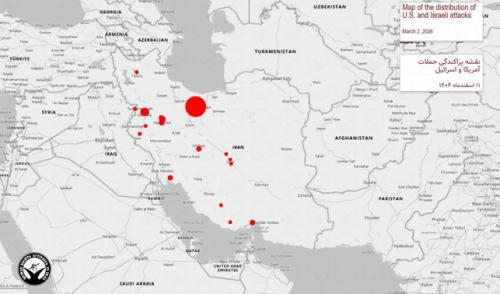
In the last 24 hours, incidents were reported across multiple provinces, reflecting a geographically dispersed pattern of hostilities. Documented incidents include airstrikes and missile attacks.
Preliminary analysis indicates that Tehran Province, accounting for 56% of the attacks, continues to be targeted more than any other part of the country. Unlike previous days, when West Azerbaijan and East Azerbaijan provinces ranked second and third in terms of the number of attacks, today Kurdistan and Hormozgan provinces hold those positions, with shares of 8% and 7%, respectively.
2- List of Objects Reported Hit
In the last 24 hours, the following objects were reported as hit. Please note that this list includes not only objects reportedly directly targeted, but also those documented as damaged as a result of nearby strikes or blast effects. This list is not exhaustive; the items listed are illustrative.
- The Law Enforcement Command Headquarters of Kurdistan, located in Sanandaj
- The Kurdistan Border Guard Command Center, located in Sanandaj
- The 8th Tactical Air Base (Islamic Republic of Iran Air Force) in Isfahan was targeted
- The Army’s Self-Sufficiency Jihad Base in Tehran was targeted
For a number of the above-listed objects, the precise nature of the target, whether civilian, military, or dual use, remains under review. Verification efforts are ongoing to determine the status and function of each object at the time of the reported strike. As further information becomes available, classifications may be revised in subsequent updates.
3- Facilities Protected Under International Humanitarian Law:
Under international humanitarian law, medical facilities, educational institutions, humanitarian facilities, religious sites, and emergency service centers are among the many objects that maintain special protected status and are afforded special protection.
As of the past 24 hours, HRANA documents reported damage to the following facilities protected by IHL. The information below reflects preliminary findings and remains subject to verification. This list is not exhaustive; those listed are illustrative.
- A mosque in Mehrshahr, Karaj, was targeted
- A residential building on Shariati Street in Tehran was targeted
- The governor’s office in Rey was targeted
- Shahid Bahonar Pier in Bandar Abbas was targeted
- A residential complex on Sepahbod Qarani Street in Tehran was targeted
All casualty figures presented below are based on information available at the time of publication. The classification of individuals as civilian, military, or undetermined is preliminary and subject to change as further verification is conducted. Where sufficient corroboration is not yet available, cases remain under review and may be reclassified in subsequent updates.
In the last 24 hours, 85 civilians were reported killed, and 5 civilians were reported injured across 13 provinces. Among them, 1 children were killed.
The highest number of civilian casualties was documented in the city of Ilam, Ilam Province, followed by Kurdistan Province.
In Tehran, a particularly severe incident occurred when an airstrike damaged the Iranshahr Street Emergency building and several adjacent buildings. These incidents continue to be reviewed as additional documentation becomes available.
5- Military Casualties
During the same reporting period, 11 military personnel were reported killed. This figure for military casualties is limited exclusively to those reported in connection with attacks on military or paramilitary bases. Where possible, organizational affiliation and operational context are being assessed; however, not all details have been independently verified.
In certain incidents, individuals were killed in proximity to military objectives, but their formal status has not yet been conclusively established. These cases remain under review, and classification may be revised if credible information indicates a different status.
6- Unverified Casualties
As of publication, 52 casualties remain under active review and are currently classified as undetermined.
Classification may remain pending due to:
- Lack of identifying documentation
- Conflicting reports from sources
- Insufficient information regarding affiliation or role at the time of death or injury
- Ongoing efforts to verify open-source reports through the HRANA network
Several incidents and casualties documented in this reporting period remain under review due to incomplete or conflicting information. These cases are recorded but are not yet fully verified or cannot yet be reliably classified, and may be updated as additional corroboration becomes available.
7- Undetermined Casualties
As of the time of publication, 579 casualties (deaths and injuries) remain classified as undetermined. This includes cases where HRANA has not yet been able to confirm whether the individual was a civilian or military personnel, or where age status (including potential child casualties) has not been conclusively verified.
A Note on HRANA Methodology
The information contained in this report is compiled through HRANA’s established documentation network. Data is collected from a combination of field reports, local contacts, medical and emergency sources, civil society networks, and open source materials, including publicly available images, videos, and official statements where relevant. Each reported incident is logged and assessed through an internal review process before publication.
Given the evolving nature of hostilities, information is gathered on a rolling basis and reflects the status of documentation at the time of publication.
The figures presented in this report may not reflect the full scope of harm. Ongoing hostilities, damage to infrastructure, communication disruptions, restricted access to affected areas, and security risks for sources may limit the ability to document incidents comprehensively.
Delays in medical reporting, difficulties in confirming identities, and restricted access to certain provinces may result in temporary undercounting. As access improves or additional evidence emerges, casualty figures and incident classifications may be revised accordingly.
HRANA remains committed to transparency, methodological rigor, and the continual updating of its findings as new verified information becomes available.
Humanitarian Obligations
HRANA reiterates that all parties to the conflict are bound by international humanitarian law and must at all times distinguish between civilians and combatants, and between civilian objects and military objectives. Attacks directed against civilians or civilian objects, as well as indiscriminate attacks, are prohibited. All parties are required to take all feasible precautions to minimize civilian harm and to protect facilities afforded special protection, including medical units, schools, humanitarian facilities, religious sites, and objects indispensable to the survival of the civilian population.
HRANA further underscores the obligation under human rights law of the Islamic Republic of Iran to ensure access to information. Authorities must refrain from imposing internet shutdowns, communication disruptions, or other restrictions that impede the flow of information, obstruct documentation efforts, or prevent families from obtaining information about the fate and whereabouts of their relatives. Transparency and access to information are essential for civilian protection and the effective delivery of humanitarian assistance.
As seen in the documentation in this report, armed conflict brings profound destruction and suffering to civilians and deepens humanitarian crises. HRA calls for an immediate cessation of hostilities and a renewed commitment to a peaceful resolution grounded in international law. The continued loss of civilian life, including that of children, underscores the urgent need to prioritize the protection of human life above all else.
The protection of civilians and the safeguarding of fundamental rights, including access to information, are binding legal obligations. The pursuit of peace remains essential to preventing further harm.