
15 January 2026 :
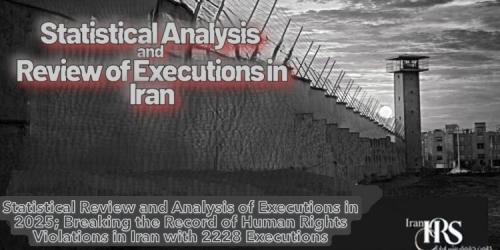
January 9, 2026 - IRAN. Iran-HRS Year End Report: 2228 executions
The Bloodiest Year in the Past Four Decades
The year 2025 was recorded as one of the darkest periods in Iran’s contemporary history; a year in which the execution policy not only did not stop but expanded with unprecedented speed and led to an unprecedented record. In December alone, 403 prisoners were executed, and the total executions in this year reached at least 2228 people; statistics that reveal the extent and depth of the country’s legal and social crisis.
Overall Execution Statistics
Based on recorded data, in 2025, at least 2228 prisoners were executed in 97 cities across 31 provinces of the country. This statistic includes 64 women, 6 juvenile offenders who were under 18 at the time of the alleged crime, 13 public executions, 19 political prisoners, 38 prisoners charged with rebellion, enmity against God, and corruption on earth, 14 prisoners charged with espionage, 1002 people charged with drug-related offenses, and 1093 people charged with murder. The geographical spread and diversity of charges indicate the systematic use of execution as a tool for control and intimidation.
In the same year, the execution rate among ethnic minorities was significantly higher. 162 Baluch prisoners and 115 Kurdish prisoners are among those executed. In addition, 95 Afghan nationals were also executed in Iranian prisons; statistics that once again highlight the issue of structural discrimination and the vulnerability of marginalized groups.
Executions of Women
Among those executed in 2025, at least 64 women are recorded; a figure that is almost double the executions of women in 2024 (34 women). This significant increase is a sign of the intensification of a repressive approach that does not spare gender and places women, whether in general crimes or complex judicial cases, at risk of deadly punishments.
Age of the Executed; Youth Hanged
Out of the total 2228 victims, the age of 881 is known. The average age of the executed is estimated at about 36 years; a range that includes young people aged 18 to individuals aged 71. This age distribution shows that executions are not imposed on a specific group but on a wide spectrum of society, eliminating a significant portion of the country’s productive and active workforce from the cycle of life.
Cities and Prisons; Concentration of Executions in Specific Centers
The highest execution statistics were recorded in Tehran and Qezel Hesar Prison; with at least 221 cases, accounting for about 10 percent of the total executions in the year. Although Qezel Hesar Prison is located in Karaj, it is considered a Tehran prison in the administrative structure of the prisons organization. After Tehran, the cities of Isfahan with 158 executions, Shiraz with 149, Mashhad with 80, Kermanshah with 75, Tabriz with 67, Yazd with 66, Qom with 63, and Ahvaz and Khorramabad each with 60 executions top the list. The high concentration in these cities indicates the central role of certain prisons in implementing the execution policy.
Executions Related to General Crimes and Drugs
In 2025, 1002 of the executed were charged with drug-related offenses; that is, about 45 percent of all executions. The implementation of the death penalty for this category of crimes occurs in a situation where this approach is practically limited to Iran. At the same time, reports indicate the role of powerful networks and mafia structures in the drug cycle; an issue that highlights the contradiction between punishing the smallest links and the immunity of the main actors.
On October 13, 2025, about 1500 prisoners in Unit 2 of Qezel Hesar Prison – who were mostly sentenced to death in drug cases – went on a hunger strike for a week and prevented executions. This collective action forced the judiciary to retreat and suspend the executions of drug convicts in this prison for six months until a new law is presented.
Executions for murder
In the same year, 1093 people were executed on murder charges, accounting for about 49 percent of all executions. Murder, in many cases, is a reflection of economic pressures, widespread poverty, and livelihood crises. According to statements from an expert affiliated with the regime, more than 40 million people are below the poverty line and 7 million below the hunger line. The increase in petty thefts, livelihood conflicts, and daily violence has created a social context in which the death penalty, instead of addressing root problems, has become the dominant response.
Five-Year Comparison
Statistical comparison shows that executions in 2025 increased 6.7 times compared to 2021 with 333 executions. This figure is 3.8 times compared to 2022 with 582 executions; 2.6 times compared to 2023 with 853 executions; and 2.2 times compared to 2024 with 1006 executions. This upward trend indicates an unprecedented acceleration in the application of the death penalty.
Public Executions and Geographical Expansion
In 2025, executions were recorded in 97 cities; while this number was 77 cities in 2024. The increase in geographical scope indicates an effort to instill public fear. In the same year, 13 prisoners were executed in public; a figure that is about 2.5 times higher than the previous year with 5 cases. Also, the statistics for the second half of the year are more than double the first half; a sign of the intensification of a policy that, amid accumulating crises, resorts to violence instead of reform.
In total, the year 2025 presents a clear picture of the intensification of the execution policy in Iran; a policy that not only has not diminished in intensity but has reached a historical record and left profound social, human, and legal consequences.
Juvenile Offender Executions
Among the executed, there were 6 juvenile offenders:
- Mehdi Matavali: 20 years old, executed on April 9, 2025, on murder charges in Arak.
- Behzad…..: 20 years old, executed on April 9, 2025, on murder charges in Gonbad-e Kavus.
- Mohammad Reza Sabzi: 20 years old, executed on May 13, 2025, on murder charges in Malayer.
- Hadi Soleimani: 18 years old, executed on May 14, 2025, on murder charges in Shiraz.
- Mohammad Reza Shiyaki: 25 years old, executed on October 2, 2025, on murder charges in Iranshahr.
- Ali Aghajari: 22 years old, executed on October 20, 2025, on murder charges in Ahvaz.
- Farhad Shakri: Sunni political prisoner, executed on April 8, 2025, on charges of membership in the Salafi group Hizb al-Furqan in Mashhad Prison.
- Abdul Hakim Azim Gorgij: Sunni political prisoner, executed on April 8, 2025, on charges of membership in the Salafi group Hizb al-Furqan in Mashhad Prison.
- Abdul Rahman Gorgij: Sunni political prisoner, executed on April 8, 2025, on charges of membership in the Salafi group Hizb al-Furqan in Mashhad Prison.
- Taj Mohammad Khormali: Sunni political prisoner, executed on April 8, 2025, on charges of membership in the Salafi group Hizb al-Furqan in Mashhad Prison.
- Malek Ali Fadaei Nasab: Shia political prisoner, executed on April 8, 2025, on charges of membership in the Salafi group Hizb al-Furqan in Mashhad Prison.
- Ali Dehani: 22-year-old political prisoner, executed on April 14, 2025, on charges of killing 4 police officers at his service station in Zahedan Prison.
- Hamid Hossein-Nejad Heydaranlu: 40-year-old political prisoner, executed on April 21, 2025, on charges of participation in the killing of 8 border guards in Urmia Central Prison.
- Rostam Zein al-Dini: 30-year-old political prisoner, executed on April 26, 2025, on charges of collaboration with Jaish al-Adl in Zahedan Prison.
- Mujahed Korkor (Abbas): Political prisoner and one of those arrested in 2022 in Izeh, executed on June 11, 2025, on charges of forming an armed group in Sheiban Prison, Ahvaz.
- Behrouz Ehsani: 70-year-old political prisoner, executed on July 27, 2025, on charges of membership in the Mujahedin-e Khalq in Qezel Hesar Prison.
- Mehdi Hassani: 48-year-old political prisoner, executed on July 27, 2025, on charges of membership in the Mujahedin-e Khalq in Qezel Hesar Prison.
- Mehran Bahramian: 32-year-old political prisoner, executed on September 6, 2025, on charges of enmity against God and action against national security in Dastgerd Prison, Isfahan.
- Ali Mojadam: 44-year-old political prisoner, executed on October 4, 2025, on charges of rebellion in Sheiban Prison, Ahvaz.
- Mohammad Reza Moghadam: 33-year-old political prisoner, executed on October 4, 2025, on charges of rebellion in Sheiban Prison, Ahvaz.
- Moein Khanfari: 31-year-old political prisoner, executed on October 4, 2025, on charges of rebellion in Sheiban Prison, Ahvaz.
- Habib Deris: 42-year-old political prisoner, executed on October 4, 2025, on charges of rebellion in Sheiban Prison, Ahvaz.
- Seyed Adnan Mousavi Ghibshavi: 29-year-old political prisoner, executed on October 4, 2025, on charges of rebellion through membership in the Arab Struggle Movement in Sheiban Prison, Ahvaz.
- Seyed Salem Mousavi al-Bushokeh: 41-year-old political prisoner, executed on October 4, 2025, on charges of rebellion through membership in the Arab Struggle Movement in Sheiban Prison, Ahvaz.
- Saman Mohammadi Khiyareh: 35-year-old Kurdish political prisoner, executed on October 4, 2025, on charges of enmity against God and membership in groups in Qezel Hesar Prison.
Reasons for the Increase in Execution Statistics
Many human rights analysts believe that the increase in executions is not merely the result of rising crimes or judicial policies, but is directly linked to the country’s political and social conditions. In recent years, the regime has faced various challenges: widespread public protests, severe economic problems, declining domestic legitimacy, and international pressures. These factors have caused the regime to feel greater insecurity and instability.
In such conditions, according to experts, the regime uses tools like increasing executions to create fear, prevent protest gatherings, and control society. This type of policy is commonly seen in regimes facing multiple crises and trying to maintain their apparent cohesion through harsh methods.
The increase in executions, especially in 2025, could be a sign that the regime sees itself on the brink of serious threats and is using this method to push back waves of protests or social changes.
Given the current trend, many human rights organizations have warned that if this situation continues, execution statistics may continue to rise in the coming years, unless significant political changes or international pressures are applied.
“No to Execution Tuesdays” Campaigns
In recent years, the “No to Execution Tuesdays” campaign has been recognized as one of the most persistent and effective forms of protest against the death penalty. This movement, which initially started on social networks and on a limited scale, gradually turned into a broader collective action and now brings together a wide range of families of death row convicts, political activists, students, and human rights supporters.
One of the important features of this campaign is its weekly continuity. Every Tuesday, activists and families draw public attention back to the issue of execution by publishing new messages, images, and statements, and raise the necessity of its abolition. This continuity has ensured that the topic of execution, which was previously less visible amid a flood of news, now has a fixed place in social and media discussions.
In addition, the “No to Execution Tuesdays” campaign has been able to create a network of solidarity among affected families; a network that on one hand removes them from social isolation and on the other hand forms a collective voice to protest the cycle of state violence. This solidarity has also provided the ground for attracting the attention of international human rights institutions and has increased pressures for holding the regime accountable.
Many analysts believe that the continuity and expansion of this movement, especially relying on public participation and regular documentation of human rights violations, can play an important role in reducing and even stopping the growing trend of death penalty executions in Iran.
Social and Human Rights Consequences of Execution
The death penalty does not only affect the convicted individual; its effects directly impact the family and society as well. One of the most evident consequences is the severe psychological and emotional pressure on the families of prisoners. Family members live in conditions of anxiety, fear, and uncertainty from the time of trial until the execution of the sentence. This chronic pressure can lead to depression, mental disorders, and social isolation.
Children of convict families also face social stigma and experience feelings of insecurity and helplessness; this experience can have long-term effects on their psychological and social development. In addition, execution imposes a heavy economic burden on families; many convicts are the breadwinners of the family, and after the execution, the family faces serious livelihood problems. The costs of trials, lawyer fees, and ongoing efforts to reduce the sentence or delay its execution make families’ financial situations highly vulnerable and strengthen a cycle of social deprivation and poverty.
On a macro level, execution has broad social and political consequences. Society, instead of experiencing justice and security, faces the reproduction of fear, repression, and restrictions on freedoms. Each execution carries an implicit message: opposition to the power structure can have a deadly cost. This repressive atmosphere not only reduces public trust in the regime but also creates serious obstacles to social and political development. Therefore, execution, instead of solving social issues, exacerbates human and political crises.