
11 December 2025 :
10 December, World Human Rights Day
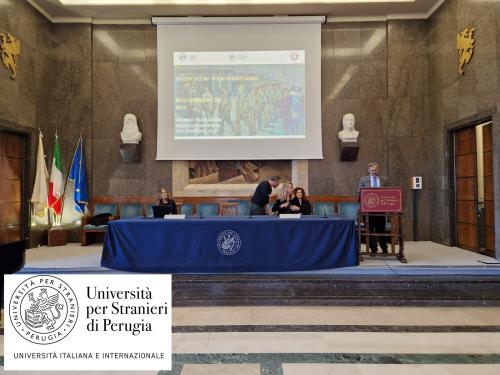
Yesterday, at the prestigious University for Foreigners in Perugia, an uncensored reflection was dedicated to the history of the gulags. Through archive footage of the Soviet concentration camp system and readings by the writer Varlam Salamov, who was deported to the frozen Russian region of Kolyma, a moving human story unfolded with students, teachers and a greeting from the Rector, a painful look at our times in which memory cannot be a convention that consoles us. Let it still be that document adopted by the United Nations General Assembly in its third session on 10 December 1948 in Paris, at the end of the Second World War, with Resolution 219077: the Universal Declaration of Human Rights.
Food for thought was provided by readings from “The Kolyma Tales” by Russian dissident Varlam Tichonovič Šalamov and excerpts from the French documentary “Gulag, a Soviet story”.
'Your strength is not enough for me to forget the deafening mass graves of my eternal corpses!
‘He had seen what we had never seen, what people were not supposed to see, what was not supposed to be.’
In December 2021, the Russian Federation decreed the closure of the Memorial association, accusing it of ‘administrative violations’ and ‘denigrating the historical memory of the nation’. Memorial was not just an archive: it was the historical conscience of the country. It was the place where the testimonies of the victims of Stalinist terror, the gulags, deportations and repression were collected. It was, in essence, the voice of the dead of Kolyma. Memorial collected names, stories and documents of lives broken by Stalinist terror.
Its closure is not just an act of repression: it is a declaration of war on memory.
At a time when history is being rewritten by decree, remembering becomes a historic gesture. And remembering means choosing which side to be on. It means saying that pain cannot be archived and that truth cannot be frozen. We can piece things back together, but we cannot erase them.
Entering Kolyma means remembering not only one man but entire generations. Men, women and children erased by the midwifery of violence of history, where ideology decided who died and who lived.
Memorial has been closed. But the memory of Varlam and those who died before and after him will not be. Not as long as there is someone who, in the face of the coldness of the human soul, remembers that they are still a person.
Speakers: the Rector, Valerio De Cesaris;
Marta Calzoni, journalist and lecturer;
Emanuela Costantini, University of Perugia;
Maura Marchegiani, University for Foreigners of Perugia;
Elisabetta Zamparutti, Hands off Cain-Spes contra Spem
Giacomo Nencioni, University for Foreigners of Perugia.
info 3384818474