
17 January 2026 :
January 12, 2026 - Florida. Marking a Decade Since Hurst v. Florida
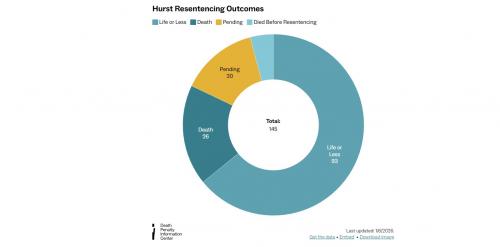
Ten years after Hurst resulted in the death sentences of 145 Florida capital prisoners being vacated, 125 (86%) cases have been resolved (119 prisoners resentenced, 6 died).
Hurst resentencings have overwhelmingly ended in life sentences. Four out of every five prisoners (78%) once sentenced to death were deemed by juries or prosecutors to merit a sentence other than death.
After Florida lowered its capital sentencing standard in 2023 from 12 unanimous votes to just eight votes, the rate of death sentences in Hurst resentencings almost doubled (17% to 33%).
Despite the lowered standard, jurors remain reluctant to impose death. Two-thirds of Hurst proceedings since the new law took effect have ended in life sentences. In Hurst resentencings under the 8 – 4 standard, juries have imposed life sentences in at least 12 cases and unanimously imposed only one death sentence.
Introduction
Today is the ten-year anniversary of the U.S. Supreme Court’s decision in Hurst v. Florida. Heralded as a watershed ruling for capital defendants, Hurst reaffirmed the principle that the jury alone must find the facts necessary to condemn a person to die — implicating the death sentences of hundreds of prisoners across three states. The Sixth Amendment right to an impartial jury is one of a suite of constitutional guarantees meant to ensure fairness and consistency in the criminal legal system.
“The jury’s role in sentencing — particularly in capital cases — is central,” the New York Times Editorial Board wrote approvingly on the day of the ruling. The Court had correctly struck down a law that “treated the Constitution as little more than a speed bump on the road to quicker and easier death sentences.”
Yet implementing Hurst in its state of origin, Florida, has been easier said than done. Hurst eligibility and resentencing outcomes have been the subject of ongoing litigation for the past decade, impacted by inconsistent state court rulings, new legislation, and even hurricanes. Several cases still have not been presented to a jury for resentencing. Today, these factors have given rise to serious concerns that the constitutional promise of Hurst has not been realized.
Legal Background: Hurst v. Florida
In Hurst v. Florida, the Supreme Court held that Florida’s long-standing capital sentencing scheme violated capital defendants’ right to jury trial under the Sixth Amendment to the U.S. Constitution. The issue had been pending for 14 years, since the Supreme Court held in Ring v. Arizona (2002) that “the jury, not the judge, must find the factors that warrant imposition of capital punishment.”
Florida’s pre-Hurst capital sentencing scheme required the jury to only make a final recommendation of death by a vote of 7 – 5 or more. It permitted the judge to find the aggravating factors required for a death sentence. In Hurst, the Court struck the statute, holding: “The Sixth Amendment requires a jury, not a judge, to find each fact necessary to impose a sentence of death. A jury’s mere recommendation is not enough.”
When Hurst was decided, only three states allowed death sentences to be imposed following a jury’s nonunanimous recommendation for death: Alabama, Delaware, and Florida. For prisoners in those states, how the state responded to Hurst would mean the difference between life and death. In August 2016, Delaware commuted each death row prisoner’s sentence to life, imposed a unanimous sentencing requirement, and eventually abolished the death penalty. In September 2016, the Alabama Supreme Court held in Bohannon v. State that Alabama’s capital sentencing scheme passed constitutional muster even after Hurst because “a jury, not the judge, determines by a unanimous verdict the critical finding that an aggravating circumstance exists beyond a reasonable doubt to make a defendant death-eligible.” Alabama retained its nonunanimous sentencing requirement for death by a vote of at least 10 jurors.
In October 2016, the Florida Supreme Court held in Hurst v. State that “all the critical findings necessary before the trial court may consider imposing a sentence of death must be found unanimously by the jury.” Under the state’s capital sentencing scheme, the Florida court explained, such findings included “the existence of each aggravating factor that has been proven beyond a reasonable doubt, the finding that the aggravating factors are sufficient, and the finding that the aggravating factors outweigh the mitigating circumstances.” The court further held, “based on Florida’s requirement for unanimity in jury verdicts, and under the Eighth Amendment to the United States Constitution, that in order for the trial court to impose a sentence of death,” the jury’s final recommendation for death must be unanimous.
Ultimately, through a series of decisions regarding how to apply Hurst, the Florida Supreme Court granted new sentencing hearings to 145 (37.6%) of the 386 prisoners on death row at the time Hurst was decided.1
Florida’s 2023 Statute
In the years after Hurst, following several changes to the composition of both the U.S. and Florida Supreme Courts, the law changed again. In January 2020, the Florida Supreme Court, in State v. Poole, overturned its prior decision in Hurst v. State and held that the only finding the jury must make to satisfy the Sixth Amendment and, therefore, the U.S. Supreme Court’s decision in Hurst v. Florida, is that the State proved one aggravating factor beyond a reasonable doubt — the finding that renders a capital defendant eligible for the death penalty.
While some suspected that the Florida Legislature would amend the State’s capital sentencing statute in light of Poole, that didn’t happen. Florida retained unanimity for sentencing decisions for several years. However, when three jurors in the 2022 trial of Nikolas Cruz refused to vote for the death penalty, resulting in a sentence of life without parole, Governor Ron DeSantis called on the legislature to lower the capital sentencing standard. Mr. Cruz had been convicted of killing 17 people in the 2018 shooting at Marjory Stoneman Douglas High School in Parkland, Florida.
In the 2023 legislative session, using the foundation laid by Poole, the Florida Legislature amended Florida’s capital sentencing scheme to require only that a jury find unanimously one aggravating factor beyond a reasonable doubt and recommend a sentence of death by a vote of 8 – 4 or more. When the statute went into effect on April 20, 2023, Florida became the state with the lowest standard in the country for imposing a death sentence.
By April 20, 2023, 85 (58.6%) of the 145 Hurst resentencing proceedings had been completed. Only 15 had resulted in new death sentences, while the other 70 resulted in the prisoner being resentenced to life in prison, leaving fifty-seven (39.3%) of the Hurst resentencing proceedings pending.
Immediately, litigation began across the State of Florida regarding the constitutionality of the new statute and its application — both to new and pending cases. Just last month, after almost three years, the Florida Supreme Court finally decided the issue by rejecting the constitutional challenges to the 2023 statute in two cases—Jackson v. State and Hunt v. State.2
Current Status of Hurst Resentencing Proceedings
Ten years after Hurst, Florida is still not done with resentencings: 125 (86%) of 145 cases have resolved, with 20 pending. Two additional prisoners received nonunanimous jury recommendations for death in 2025 but remain in the “pending” count as they have not yet been formally resentenced. Several of the 20 pending cases have resentencing hearings scheduled for early 2026.
The completed proceedings have overwhelmingly resulted in life sentences. Of the 119 Hurst resentencings that have occurred, 93 (78%) ended in life without parole or a lesser sentence. This means that four out of every five prisoners once sentenced to death and later granted Hurst relief were deemed by juries or prosecutors to merit a lesser punishment. Several factors may have contributed to this phenomenon. Many of the prisoners were sentenced to death in the 2000s, when prosecutors pursued death sentences more frequently, capital defense counsel were inadequately funded and resourced, and public support for the death penalty was much higher. Jurors today may be more critical of the death penalty than they once were, as wrongful convictions, official misconduct, and the traumatic backgrounds of capital defendants have received more attention. And prosecutors may be more cautious of the high cost of capital trials and appeals, face difficulties using witnesses and evidence from long-ago crimes, or recognize a defendant’s reduced culpability (such as evidence of intellectual disability that emerged after the initial prosecution). Indeed, the state waived the death penalty for dozens of prisoners eligible for Hurst resentencings, including at least 11 cases resolved after Florida passed its 2023 capital sentencing scheme.
One factor is clear: a unanimous jury standard results in fewer death sentences. All prisoners eligible for Hurst relief were originally sentenced to death by divided juries, some by a bare majority of seven votes. Most of those resentenced to life after Hurst had the benefit of Florida’s post-Hurst unanimity standard, which remains the standard in every other state besides Alabama. Research suggests that non-unanimity laws mask juror concerns about the strength of the evidence or whether the defendant deserves death; they also tend to dilute the votes of jurors of color.
The effect of Florida’s 8 – 4 law can be seen in the data: under the unanimous standard, 83% of Hurst proceedings ended in life sentences, which dropped to 67% after the standard was lowered. The proportion of death sentences has doubled.
Advocates argue that the application of vastly different jury sentencing standards to members of the same Hurst-eligible class has resulted in unconstitutional arbitrariness and unequal treatment. For instance, Alan Wade, Tiffany Cole, and Michael James Jackson were all sentenced for the same crime and had their death sentences vacated following Hurst. Mr. Wade was spared in 2022 when his resentencing jury failed to reach a unanimous vote for death. But Ms. Cole and Mr. Jackson’s resentencing hearings occurred the following year, when the lower sentencing standard had taken effect. Only two jurors voted for death for Ms. Cole, resulting in a life sentence, while the bare minimum of eight jurors voted for death for Mr. Jackson. This vote would have resulted in a life sentence had it occurred just a year earlier — and in every other state — but condemns him to death in Florida.
According to Maria DeLiberato, Legal and Policy Director of Floridians for Alternatives to the Death Penalty, Mr. Jackson’s resentencing was delayed at one point because of a hurricane. “The Supreme Court in Furman told us the death penalty is unconstitutional when it is applied in an arbitrary and capricious manner — as random as a lightning strike,” she said. “And look what happened here: a man is facing execution because his trial was delayed by an act of nature.”
As another example, the Hurst resentencing trial of Troy Victorino and Jerone Hunter was already underway when Governor Ron DeSantis signed the 8 – 4 standard into law. The jury had already been instructed that they could only impose death unanimously. The state successfully argued that the new standard should apply, leading the trial court to declare a mistrial. In 2025, they were each sentenced to death on four lopsided nonunanimous counts: Mr. Hunter by votes of 11 – 1, 8 – 4, 11 – 1, and 9 – 3, and Mr. Victorino by two votes each of 10 – 2 and 9 – 3.
Since Florida lowered its jury standard, at least 42 individual juror votes have been cast for life in Hurst retrials, only for a death sentence to be imposed.
Even though the proportion of life sentences has fallen since the 8 – 4 standard took effect, a strong majority of cases — two-thirds — have still ended in life. This is in part because prosecutors continue to waive the death penalty in high numbers. However, it also confirms jurors’ growing reluctance to impose capital punishment; at least twelve cases ended in life after prosecutors failed to garner the minimum eight votes for death. And of the ten death sentences that have been secured in Hurst proceedings under the 8 – 4 standard, nine were imposed by divided juries. Put differently, the state has produced only a single unanimous death sentence in a Hurstresentencing trial since lowering its jury standard in 2023.
Finally, Florida’s record-setting year of executions in 2025 cannot be overlooked in the context of Hurst. When deciding which state prisoners were eligible for Hurst resentencing, the Florida Supreme Court set a cutoff date, denying relief to all prisoners whose death sentences were finalized before the U.S. Supreme Court’s 2002 decision in Ring. At least seven of the 19 Florida prisoners executed last year were sentenced under the scheme found unconstitutional in Hurst and would have been eligible for resentencing but for the cutoff date. For instance, decorated Air Force veteran Edward Zakrzewski died by lethal injection on July 31, 2025, sentenced to death by a bare minimum 7 – 5 jury vote; his sentence was finalized three years before Ring.
Conclusion
While the Hurst decision was welcomed as a “win” for capital defendants, it has, in application, resulted in a decade of uncertainty for those of Florida’s death row because of the actions of the state courts and legislature. In Florida, death sentences and executions appear more arbitrary than ever, and another wave of litigation regarding the constitutionality of Florida’s revised capital sentencing scheme has already started.
https://deathpenaltyinfo.org/marking-a-decade-since-Hurst-v-florida