

18 January 2026 :
January 14, 2026 - USA. New Analysis of Racial Bias and Death Eligibility in 2025
Justin D. Levinson and Rachel G. Schaefer recently published Flawed Framework, Fatal Discretion: Unraveling Implicit Bias in Capital Punishment Decisions. The article synthesizes multiple studies examining the role of implicit bias among key decisionmakers within the legal system. The authors use this research as evidence of both the historical and ongoing influence of implicit bias on the administration of the death penalty.
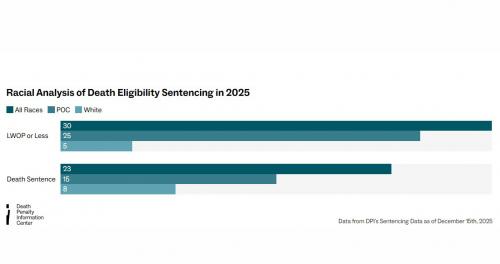
In 2025, 75% of defendants against whom state prosecutors across death eligible states sought death sentences were people of color (POC). This disproportionate representation is consistent with research, highlighted by the authors, demonstrating the role of racial bias in capital charges and sentencing decisions. One notable referenced study by Jennifer Eberhardt and her colleagues found that the likelihood of a death sentence for Black defendants increased as their facial features were perceived as more stereotypically Black. Black defendants with more stereotypical features were significantly more likely to be sentenced to death than Black defendants with less stereotypical features, highlighting how implicit racial bias influences capital trial outcomes.
Juries historically play a central role in the racially disparate application of the death penalty. DPIC’s 2025 data show that only 48% of new death sentences imposed on POC were imposed by unanimous juries. Authors Levinson and Schaefer cite research from Justin Levinson, Robert Smith, and Danielle Young to illustrate how racial bias operates within jury decision-making. Their study concluded that citizens who would be considered death-qualified jurors held stronger implicit and explicit racial biases than those who would be excluded because of their opposition to the death penalty.
At the same time, DPI found that more death-eligible people of color were sentenced to life without the possibility of parole (LWOP) than to death in 2025, reflecting broader shifts in public attitudes toward capital punishment. Gallup polling shows that support for the death penalty has fallen to its lowest level in more than 50 years, declining from 80% in 1994 to 52% in 2025. A 2020 Gallup poll further found that nonwhite respondents opposed the death penalty by a margin of 51% to 47%. While declining public support has reduced the number of death sentences imposed, racial disparities remain deeply embedded in decisions about death eligibility and alternative punishments such as LWOP.
https://deathpenaltyinfo.org/new-analysis-of-racial-bias-and-death-eligibility-in-2025