
15 April 2026 :
April 7, 2026 - USA. 5.5 million people are under the control of the criminal legal system
2 million in prison, 3 million under probation, 530.000 on parole
Punishment Beyond Prisons 2026
The U.S. confines nearly 2 million people in prisons, jails, and detention centers, a fact which we only know by piecing together data from siloed parts of the criminal legal system. But even this number does not capture the full picture of the U.S. system of mass punishment, which ensnares 5.5 million people in incarceration, community supervision, and other forms of control and surveillance.
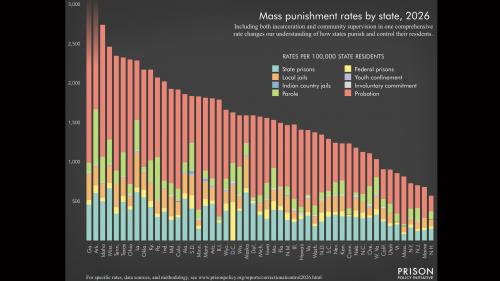
The vast majority of people in the mass punishment system are on community supervision, either under probation (3 million people) or parole (536,000 people). Yet these massive systems do not receive nearly as much attention as incarceration despite their broad harms and high failure rates. Policymakers and the public must understand how deeply linked these systems are to mass incarceration to ensure that these “alternatives” to incarceration aren’t simply expanding it. To that end, this report is designed to help state policymakers and the public assess the scale and scope of their entire correctional systems.
The report presents updated data for all 50 states and D.C. on federal and state prisons, local jails, Indian country jails, probation, parole, youth confinement, and involuntary commitment. The data suggest that states’ reliance on different systems of punishment varies widely, with supervision often designed around failure and punishment rather than support and stability. We’ve made the updated statistics available in 100+ state-specific pie charts and a data appendix.
The U.S. keeps millions of people on probation and parole every day. Rather than serving as an alternative to incarceration, supervision is often a tripwire to harsher punishments.
In many states, the number of people on probation or other forms of “community supervision” far outstrips the number of people behind bars. In a new report, Punishment Beyond Prisons 2026: Incarceration and supervision by state, the Prison Policy Initiative offers a state-by-state look at the correctional population that goes beyond prison and jail walls — while illuminating how probation and parole supervision often lead to incarceration.
From notorious “tough on crime” states like Georgia to “progressive” states like Minnesota and Rhode Island, the report shows how supervision — mainly, probation — has elevated correctional control from rare to commonplace:
If the number of people on probation and parole nationwide were its own state, it would be roughly the size of Connecticut, more populous than 21 states and D.C.
In 20 states, over two-thirds of people under correctional control are on probation or parole, rather than behind bars.
There are nearly as many people on parole — supervision after release from prison — as there are in the nation’s 3,000-plus local jails.
“Looking only at incarceration obscures the fact that millions more people are under the thumb of the correctional system, forced to comply with a litany of rules every day or face reincarceration,” said report author Leah Wang. “As lawmakers ponder how to reduce prison populations, they should look at these supervision systems, which are often a tripwire to harsher punishments.”
Punishment Beyond Prisons 2026 also includes:
An overview of incarceration and supervision populations over time, with a warning that despite pandemic-fueled downturns, many states are actually at or near peak probation populations.
A sidebar highlighting another punished population: the over 800,000 people required to be listed on public registries for sex offense convictions, despite abundant evidence that these registries do not improve public safety.
A section about people on supervision held behind bars for non-criminal rule violations, showing that these violations send more people on probation and parole to prison than do new criminal offenses.
The report highlights how certain states have enacted reforms that reduce supervision for people who do not need it. Virginia and Florida, for example, have passed laws allowing people to earn time off their probation sentences through education, employment and other achievements, while Pennsylvania now uses an individualized approach to setting probation conditions and allows for early termination of supervision.
“Supervision sentences, particularly probation sentences, are too long and keep people under correctional control far past the point where it benefits them,” said Wang. “Just as with this country’s bloated incarceration system, probation and parole can and should be drastically reduced while preserving public safety.”
The full report is at: www.prisonpolicy.org/reports/correctionalcontrol2026.html.
https://www.prisonpolicy.org/reports/correctionalcontrol2026.html