 |
 |
| IRAN - Eight Kurdish political prisoners.jpeg |
|
IRAN - 8 Kurdish political prisoners at growing risk of execution
June 9, 2026: June 9, 2026 - IRAN. Eight Kurdish political prisoners at growing risk of execution amid Iran crackdown
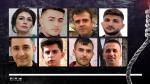
A renewed wave of executions targeting political prisoners in Iran has heightened fears over the possible execution of eight Kurdish political prisoners: Pakhshan Azizi, Pezhman Touberehrizi, Hatem Ozdemir, Yousef Ahmadi, Arman Marefati, Mohammad Faraji, Raouf Sheikh Maroufi, and Mohsen Eslamkhah. Among them, Mohsen Eslamkhah was only 16 years old when he was arrested in connection with the Woman, Life, Freedom (Jin, Jiyan, Azadi) protest movement, making him a “child offender” even under the Islamic Republic’s own legal framework.
The eight prisoners are currently being held in Evin Prison, Qezel Hesar Prison, Urmia Central Prison, Sanandaj (Sine) Central Prison, and Bukan Central Prison.
According to information received by Hengaw Organization for Human Rights, the prisoners were sentenced to death in opaque proceedings that violated the most basic principles of a fair trial. Their convictions relied on forced confessions extracted under torture and politically motivated security-related charges brought by the Iranian Judiciary, without credible supporting evidence. Throughout their detention and imprisonment, they have been denied fundamental rights and protections. Given the current political and security climate in Iran, the risk of their execution has increased significantly.
The Islamic Republic has intensified the execution of political prisoners during the Iran–U.S.–Israel war and throughout the ceasefire period. Meanwhile, Iranian officials have publicly threatened political prisoners and dissidents with broader crackdowns and mass killings on political and security grounds.
Based on data recorded by Hengaw’s Statistics and Documentation Center, at least 46 political prisoners and prisoners of conscience have been executed in prisons across Iran since the beginning of 2026, including eight Kurdish prisoners: Naser Bakrzadeh, Mehrab Abdollahzadeh, Ramin Zaleh, Karim Maroufpour, Arsalan Sheikhi, Amanj Karvanchi, Ashkan Maleki, and Mehrdad Mohammadinia.
Kurdish political prisoners at risk of execution
Pakhshan Azizi
Pakhshan Azizi, a Kurdish political prisoner from Mahabad, a women’s rights activist and social worker, was sentenced to death on August 14, 2024, by Branch 26 of the Tehran Revolutionary Court, presided over by Judge Iman Afshari, on charges of “baghi” (armed rebellion). The sentence was later upheld in full by Branch 39 of the Supreme Court of the Islamic Republic of Iran.
Iran’s Supreme Court has twice rejected her requests for judicial review.
Intelligence Ministry forces arrested Azizi on August 4, 2023, in Tehran’s Kharazi Township. She is currently being held in the women’s ward of Evin Prison.
Azizi had previously left Iran due to persistent threats and pressure from security agencies. While outside Iran, she researched the situation of women in the Kurdistan Region of Iraq and Syrian Kurdistan (Rojava) and carried out social work initiatives aimed at improving their conditions.
Pezhman Touberehrizi
Pezhman Touberehrizi, a 32-year-old Kurdish political prisoner from Kermanshah (Kermashan), was sentenced to death on September 1, 2025, by Branch 28 of the Tehran Revolutionary Court, presided over by Judge Amouzad, on charges of “spreading corruption on earth” (efsad-e fel arz) through alleged membership in the Mojahedin-e Khalq Organization (MEK).
Security forces arrested Touberehrizi in Tehran on January 28, 2025. He is currently imprisoned in Evin Prison.
During his detention, he was subjected to severe torture, including electric shocks and brutal beatings, and was denied medical treatment for weeks.
Yousef Ahmadi
Yousef Ahmadi, a 41-year-old Kurdish political prisoner from Baneh, was sentenced to death in September 2023 by Branch One of the Sanandaj Revolutionary Court, presided over by Judge Saeedi, on charges of “baghi” through alleged membership in the Democratic Party of Iranian Kurdistan (PDKI). Branch 39 of the Supreme Court later upheld the sentence in full.
Security forces violently arrested Ahmadi on April 26, 2020. After spending a prolonged period in the detention facility of the Sanandaj Intelligence Department, he was transferred to Sanandaj Central Prison.
Forced confessions were extracted from Ahmadi after several vertebrae in his spine were damaged under torture. He lost consciousness multiple times after being beaten with electrical cables. Security forces also threatened to harm his relatives in an effort to force him to accept the charges against him.
Ahmadi was already injured at the time of his arrest and had previously suffered a broken arm. Despite his condition, he was denied adequate medical care during his detention. He had also been receiving neurological treatment for epilepsy prior to his arrest but was deprived of access to medical care throughout interrogations.
Hatem Ozdemir
Hatem Ozdemir, a 29-year-old political prisoner from Agri Province in Kurdistan of Turkey currently held in Urmia Central Prison, was sentenced to death in May 2024 by Branch 3 of the Urmia Revolutionary Court, presided over by Judge Najafzadeh, on charges of “moharebeh” (waging war against God). The sentence was upheld in September of the same year by Branch 9 of the Supreme Court.
The Supreme Court has twice rejected his requests for judicial review.
Ozdemir was arrested on July 2, 2019, after he and a group of Kurdistan Workers’ Party (PKK) members were ambushed by IRGC Hamzeh Seyyed al-Shohada Base forces in the border areas of Chaldoran. He had been wounded and rendered unconscious by mortar fire before being transferred to the IRGC Ramadan Base detention facility in Urmia.
Following nearly 50 days of interrogation and torture at the facility, he was transferred to Urmia Central Prison. Despite suffering from kidney stones and repeated medical recommendations for surgery, he has continued to be denied adequate medical treatment throughout his imprisonment.
Arman Marefati
Arman Marefati, a 38-year-old Kurdish man from Saqqez and one of those arrested during the January protests in Tehran, was sentenced to death alongside Ashkan Maleki and Mehrdad Mohammadinia in a joint case. Branch 15 of the Tehran Revolutionary Court, presided over by Judge Abolqasem Salavati, convicted the three men on charges of “moharebeh” (waging war against God).
The death sentences of his co-defendants, Ashkan Maleki and Mehrdad Mohammadinia, were carried out in secret on June 1, 2026.
Marefati was transferred from Fashafouyeh Prison (Greater Tehran Penitentiary) to Qezel Hesar Prison in Karaj on May 24, 2026. Several days before the transfer, relatives were informed that his case had been referred to the Supreme Court. Since then, no information about his legal status or whereabouts has been made available.
Initially charged with “assembly and collusion against national security” as the third defendant in the case, Marefati’s charges were later changed by Judge Salavati to “participation in operational actions against national security, entering religious sites with the intent to destroy them, and participation in setting fire to a mosque and a seminary.” These revised allegations formed the basis of his death sentence.
Iranian authorities accused the three Kurdish men of damaging and setting fire to the Jafari Mosque and Imam Hadi Seminary in Tehran’s Gisha (Kouy-e Nasr) neighborhood, as well as destroying public property during protests on January 9, 2026.
Marefati has told relatives that he played no role in the alleged attacks, stating: “I only moved a trash bin into the street. That was everything I did.”
Before his arrest, Marefati worked at one of Tehran’s fruit and vegetable markets. He is the father of two young children from a previous marriage and is currently engaged.
Raouf Sheikh Maroufi, Mohammad Faraji, and Mohsen Eslamkhah
Raouf Sheikh Maroufi, 24, Mohammad Faraji, 23, and Mohsen Eslamkhah, 19, are three Kurdish prisoners from Bukan currently held in the city’s central prison. In late February 2026, Branch One of the Mahabad Revolutionary Court sentenced them to death on charges including “moharebeh” and “spreading corruption on earth” (efsad-e fel arz).
Their case was referred to the Supreme Court following an appeal, but no information has been released regarding its current status.
Security forces arrested Raouf Sheikh Maroufi on December 26, 2022, Mohammad Faraji on February 20, 2024, and Mohsen Eslamkhah on February 22, 2026, in connection with the Woman, Life, Freedom protest movement in Bukan.
The three prisoners were subjected to severe physical and psychological torture during interrogations aimed at extracting forced confessions.
In Mohammad Faraji’s case, Intelligence Department agents in Urmia posed as ordinary customers and contacted him requesting assistance as an auto mechanic. After asking him to come to a designated location to repair a vehicle, security forces abducted him.
Mohsen Eslamkhah had previously fled Iran and sought refuge in the Kurdistan Region due to pressure from Iranian authorities. He returned to Bukan in June 2025 and was arrested shortly afterward.
Eslamkhah was only 16 years old at the time of his arrest in connection with the Woman, Life, Freedom protests in Bukan. He therefore qualifies as a “child offender” even under the Islamic Republic’s own legal framework.
https://hengaw.net/en/reports-and-statistics-1/2026/06/article-2 (Source: Hengaw)
|